
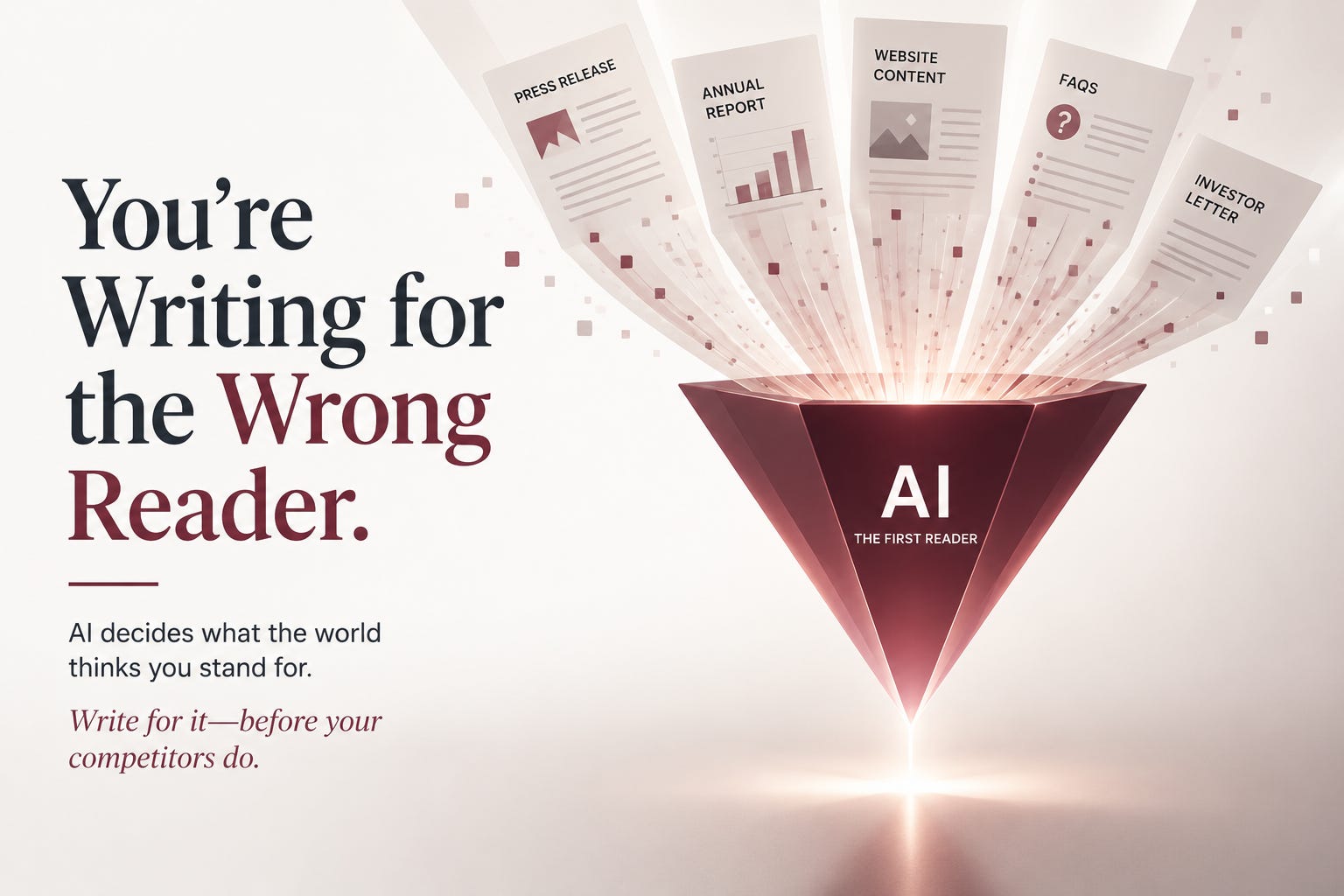
You’re Writing for the Wrong Reader
AI decides what the world thinks you stand for. Write for it—before your competitors do.

Adrian Durbin is a Partner at Greenbrier and The Messina Group. He is a senior communications and government relations expert with more than twenty years of experience handling corporate, financial, crisis, policy, and executive communications. Adrian joined Greenbrier from Lyft, where he was Head of Communications. Previously, he held multiple roles at McKesson, a Fortune 10 healthcare company, and within Massachusetts politics.
Right now, a voter is deciding whether a candidate is the real thing. A retail investor is deciding whether a stock is worth buying. A shopper is deciding whether a product is safe. None of them is reading a press release, calling their broker, or even talking to someone. They’re asking AI.
For the first time in the history of communication, the most important reader isn’t a person. It doesn’t watch debates or listen to earnings calls. It doesn’t knock on doors or sit in on a board meeting.
What it does is read everything. And then it tells everyone else what to think.
Every day, hundreds of millions of people consult this new AI audience—specifically, the large language models that power ChatGPT, Claude, Gemini, Perplexity, and dozens of other tools. And they trust the answers they receive.
The business leaders, political figures, and communications professionals who understand this shift, and who build their communications around it, will have a decisive edge over their competitors.
The New First Reader
Smart communicators have always understood that before a message reaches the bulk of its intended audience, it almost always passes through a filter—a gatekeeper that determines which elements of a message are amplified and which fade into the background.
Wire services were gatekeepers of the twentieth century. Editors at the Associated Press and United Press International decided what got covered, and therefore what was news, and therefore what the country discussed at dinner every night. Savvy press secretaries and PR men (yes, they were virtually all men) built relationships with, and wrote for, these editors, just as much as they did for the public. Ad men, meanwhile, bought space and time in the magazines, papers, and radio channels Americans most relied on to get their news.
Then came television, and with it the nightly news, the thirty-second soundbite, and extended commercial interruptions. Entire industries—political consulting, corporate PR, advertising, investor relations—all rewired themselves around what played in a television package. They recognized that if you couldn’t tell your story in 15-30 seconds, it didn’t get told.
The internet, search engines, and SEO transformed communications again at the dawn of the new millennium, forcing companies to devote themselves to optimizing their messaging not for human readers, but for the algorithms that surfaced content to human readers. Most recently, the social media era and our dwindling attention spans forced effective messaging to compress even further, into bite-sized posts and videos chasing virality.
Each of these transitions produced winners and losers. The communicators who adapted quickly, who understood and optimized for the new filter before their competitors did, pulled ahead. I’m reminded of this every day when I go to work for my boss, Jim, who helped President Obama so effectively harness modern communications strategies in his 2008 and 2012 campaigns.
But 2026 has wrought the most disruptive, most powerful filter yet. AI has inserted itself directly between communicators and their audiences in a way no prior technology has.
ChatGPT alone now has an estimated 900 million weekly active users, and traffic from AI platforms to websites surged 527% in 2025. Moreover, users aren’t just passively browsing AI tools—they’re increasingly outsourcing their opinions to them. AI-referred visitors to Shopify convert to purchases at nearly 50% higher rates than visitors from traditional searches. And in research published last December, a group of professors found that a single conversation with an AI chatbot was roughly four times more persuasive than a political advertisement.
This is the part that many PR teams and campaign strategists are missing right now. They’re still talking about “reaching voters” and “reaching consumers” as if the only readers are human. But in a growing number of consequential moments—shopping decisions, political opinion shaping, brand impressions—their first reader is not human at all.
Today and in the years ahead, the most important communications product a company or campaign produces is not a television advertisement, a shareholder letter, or a major speech (much as it pains the old speechwriter in me to admit). It’s the content that most directly shapes what AI tools say when a user asks about you.
The Playbook
The craft of political and corporate communications has long been optimized around a single constraint: attention is short.
Journalists skim press releases for the lede. Voters make snap judgments after reading a tweet or watching a commercial. Shareholders read the executive summary and the first two paragraphs of a CEO’s letter, maybe. Consumers on social media decide whether to keep scrolling in under two seconds. The entire architecture of modern professional communications—the soundbite, the top-line talking point, the thirty-second ad—was built around that constraint.
That architecture still matters, but it’s no longer sufficient. LLMs don’t have a short attention span, and they don’t skim. They compress.
When someone asks ChatGPT about a company, a candidate, an issue, or a product, the LLM doesn’t pull the three snappiest quotes from one website’s homepage. It synthesizes all relevant press releases, FAQs, structured data points, and live search results into a single, confident answer. What survives that compression isn’t what a press secretary thought was the most important message; it’s what was most clearly structured, most consistently stated, and most prominently placed across all written, public-facing content—because that’s what the model can actually read. Video clips, audio, and paywalled content are largely invisible to it.
Different models weigh these signals differently, and no single optimization works perfectly across all of them. But the underlying principle holds across the ecosystem: clarity and structure survive compression better than density and prose.
This means the discipline required to communicate effectively in the AI era is different from what came before. Today and going forward, savvy communicators need to identify what survives compression. And then they need to be relentlessly disciplined about optimizing for it, across every piece of content they produce.
Here’s what that looks like in practice:
1. Your Headline is Your Message
Models are built to heavily weigh headlines when constructing summaries. That means that, in the LLM era, your headline is the single most powerful sentence in your entire piece of content. AI-first communicators need to write their headlines as if they’re the one sentence that will survive compression—because they just might be.
A press release headline that once read something like “Acme Corp Releases Annual Results” now needs to read more like “Acme Corp Cuts Customer Energy Costs 40% While Growing Revenue—A Model for the Clean Economy.” A good rule to keep in mind is that a generic headline will yield a generic LLM summary.
The same principle applies to political messaging. “Senator Davis Votes Yes on Infrastructure Package” tells an AI nothing useful. “Senator Davis Delivers $2 Billion for Rural Broadband, Keeping Promise to Working Families” gives the model something to work with—and something to repeat when a voter asks who actually delivered for their community.
2. Structure as Signal
Similarly, models don’t just read your content. They also take cues from how your content is structured. Headers, subheadings, bullet points, and labeled sections send signals to an LLM about what’s important and how key concepts and messages relate to each other.
A press release that buries the environmental impact of a new project in paragraph seven is more likely to produce an AI summary that doesn’t mention it. Whereas a white paper with a section clearly labeled “Key Policy Commitments” will surface those commitments every time a model is asked about what a candidate or a corporation is fighting for.
Every piece of structured content you produce should be organized around what you want the AI to find. That also means auditing your existing web presence, your investor materials, and your policy pages, and reorganizing them around the signals you want amplified, not whatever organizational logic made sense to your web designer back in 2019.
3. Front-Load Everything
LLMs also operate on the inverted-pyramid principle, weighing the early portions of documents more heavily in summarization tasks. The first paragraph of your CEO letter, the first section of your policy platform, and the opening statement in your earnings call are all disproportionately represented in what the AI says about you.
Communicators’ instincts are often to build towards a key message—to earn it with context and evidence before delivering the payoff. That structure works for a human reader or listener who is engaged and patient. It fails for an AI compressing 10 sources simultaneously.
4. FAQs are Your Secret Weapon
The humble FAQ, often treated as an afterthought or a nice-to-do, is one of the highest-value content formats in the AI era. Why? Because people ask AI questions. And models love answering questions with content that is already structured as questions and answers.
The prompt “Why should I vote for Candidate X?” will yield a much better answer for a campaign that has already published a clear, crawlable Q&A page addressing a similar question in plain English. The same applies in corporate communications: “Is Acme Corp doing anything to reduce carbon emissions?” A company that doesn’t have a clear, structured, crawlable answer to that question somewhere in its public content is choosing to let the AI—and whoever else has published content about you—answer it instead.
The Window
If you’re working on communications for a company, a campaign, or a candidate, and you haven’t already begun thinking about and planning for AI as your new target audience, then you’re already risking your narrative. Someone is already asking an AI what your company stands for, what your candidate believes, or whether your product is worth buying. And the answer they’re getting is assembled from whatever bits and pieces the model can dig up and read about you.
Unlike SEO, where domain authority compounded slowly over years, the AI-first advantage may be shorter-lived. These tools are evolving fast, and a competitor can close the gap once they decide to. That makes the situation that much more urgent: the window is measured in months. For campaigns, the 2026 cycle will be the first real test of who figured this out.
For corporate communicators: start by auditing what the major AI platforms say about your company today. Ask ChatGPT, Claude, and Gemini who you are, what you do, and what you stand for. What comes back is both your starting point and your gap analysis. Then restructure your highest-traffic content around AI-first principles: clear headers, front-loaded claims, and FAQ pages that anticipate the actual questions people are asking models about you.
For political campaigns: Build structured policy content that answers, in plain language, the questions voters and donors are already asking models. Make sure your candidate’s record is told in structured, crawlable content, not just via clips that a model can’t read. And do the same for your opponent’s record.
The voter, the investor, and the shopper have already moved on. They got their answers. The only question is, did you write it?
 | A guest post by
|
REALLY smart piece